
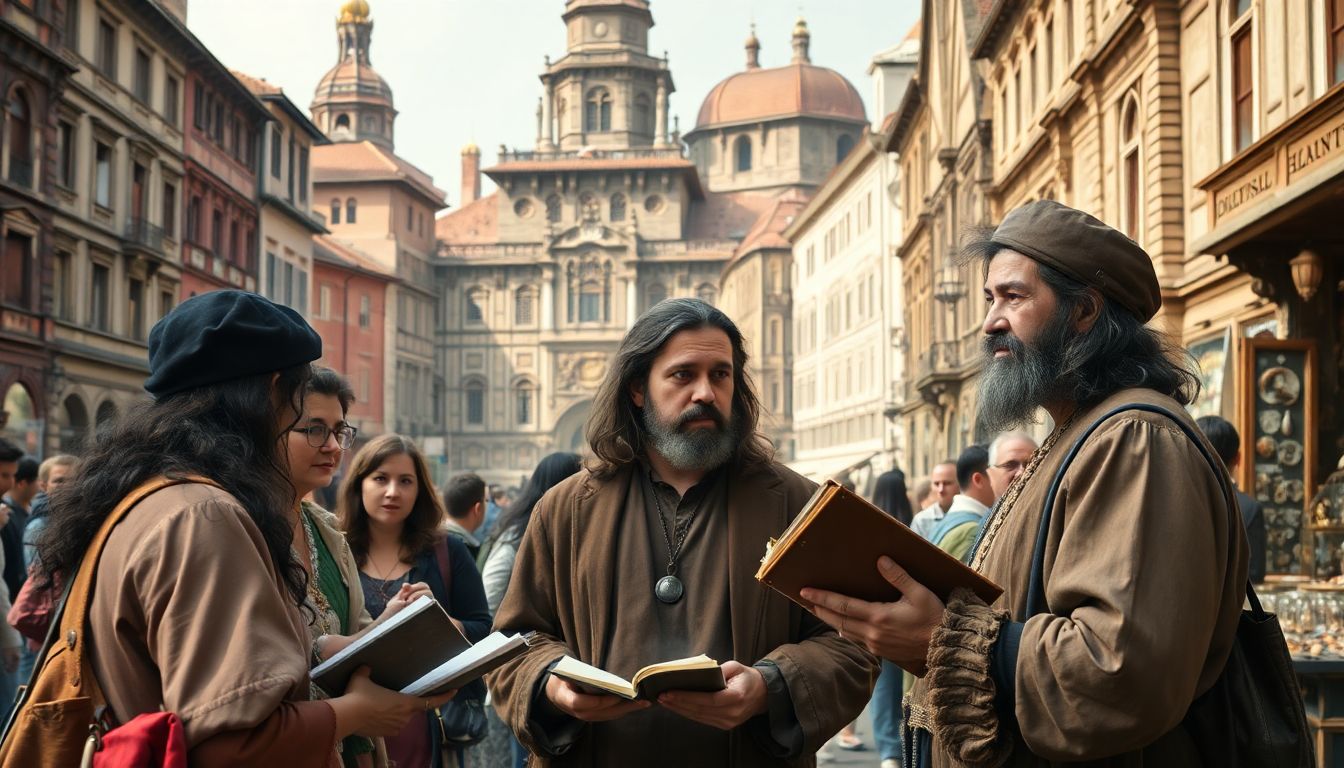
The Renaissance Revolution: How Art, Science, and Humanism Redefined Europe
What if everything you knew was wrong? Imagine a world bursting with new ideas. The Renaissance was just that. It changed how Europeans saw the world.
This period, roughly from the 1300s to the 1600s, started in Italy. The Renaissance was a time of great change. New ideas changed art, science, and thought. It set the stage for modern times.
The Renaissance revolutionized Europe. It was fueled by old knowledge, sparking art, science, and humanism. It built the foundation for the world we know today.
The Rebirth of Classical Knowledge
Old books changed everything. Thinkers rediscovered Greek and Roman texts. This sparked a new interest in classic ideas. People began to read ancient works. They learned from philosophers and writers of the past.
The Role of Humanism
What is humanism, exactly? It's a focus on human potential. Humanists believed in reason and individual achievement. Petrarch and Erasmus were key thinkers. They promoted education and critical thinking. Humanism pushed people to be their best selves.
The Impact of the Printing Press
Gutenberg's press was a game changer. This invention spread knowledge faster than ever. More people learned to read. New ideas spread quickly throughout Europe. The printing press helped the Renaissance bloom.
Artistic Flourishing: A New Visual Language
Art changed in amazing ways. Artists tried new styles. They used new techniques to show realism. The old ways of painting began to fade. A fresh look was on the rise.
Innovations in Painting and Sculpture
Artists learned about perspective. They made paintings look more realistic. Light and shadow were used to create depth. Leonardo da Vinci, Michelangelo, and Raphael were masters. Donatello was a great sculptor, too. These artists shaped the Renaissance.
Patronage and the Arts
Wealthy families supported artists. The Medici family was a major supporter. They commissioned great works of art. This support helped artists thrive. Without patrons, many masterpieces wouldn't exist.
Leonardo da Vinci: The Ultimate Renaissance Man
Leonardo da Vinci was a true genius. He excelled in art, science, and engineering. He embodied the spirit of the Renaissance. His talents knew no limits.
Art and Anatomy
Da Vinci studied the human body. His anatomical drawings were incredibly detailed. The Vitruvian Man shows his understanding. His studies improved his art. Science and art went hand in hand.
Inventions and Engineering
Da Vinci had amazing ideas. He designed flying machines and war machines. Many of his inventions were ahead of his time. He was a visionary inventor.
Scientific Revolution: Challenging Medieval Beliefs
People began to question old beliefs. Observation and inquiry became important. This led to scientific breakthroughs. The world was viewed in a new light.
The Heliocentric Model
Copernicus proposed a new idea. The Earth revolves around the Sun. This challenged the old view. It sparked a revolution in astronomy. Science began to change everything.
Advances in Astronomy and Medicine
Galileo used telescopes to study the stars. Vesalius studied the human body. These discoveries changed science. Medicine and astronomy took huge steps forward.
The Legacy of the Renaissance
The Renaissance left a lasting mark. It changed European culture and politics. New ideas transformed intellectual life. The effects are still seen today.
The Rise of Nation-States
People started to feel like they belonged to a nation. Centralized states began to form. Renaissance ideals helped shape national identities. Countries began to take shape.
The Reformation and Religious Change
Humanism had an impact on religion. People began to question the Church. This led to the Protestant Reformation. Religious change swept across Europe.
Conclusion
The Renaissance brought huge changes. It was a time of rebirth. Art, science, and humanism changed Europe forever. This period shaped the modern world. The Renaissance was a key moment in history. It continues to inspire us today.



![The Top 10 Most Powerful Countries in the World Right Now [2025 Rankings]](https://lh3.googleusercontent.com/blogger_img_proxy/AEn0k_s2Zh75_o8x0ryuhvCKrYJsBNETEc-dLGJglMHsXSf2aMx3Guj98DNS9ihW-Z1waYzE6qgNX09a70K0ZXVmyv21cmZ3vUIT44vYBO90y35uz2ehnMz4TGhUvweFsNDh1Z2XibRmYtqm4hq9215VUfiDqdXYqYH87DDUL3BFY_3U--UAlW_3g9aC2bduGoB5YYoDNkA=w72-h72-p-k-no-nu)
0 Comments